


Program 7-5-16 “Authority Through Respect”
7 “The Chariot” · 5 “The Hierophant” · 16 “The Tower”
The 7-5-16 program, Authority Through Respect, is a combination of the Chariot, the Hierophant, and the Tower. Its core: you devalue other people's achievements because you don't believe in your own. Criticism and gossip instead of growth are a road to nowhere. The resource is learning to respect other people's achievements — and that's when you become an authority yourself. What's distinctive about this triad is that it appears in twelve different places on the chart, and the placement decides where it shows up, not what it means. Wherever it sits — in the Tail, in the channels, or in the ancestral lines — the plot is the same: your insecurity hides behind criticism of other people's wins.
Is 7-5-16 in Your Matrix?
The widget calculates the triplets across every place in the matrix from your date of birth and highlights where the program “Authority Through Respect” sits.
What the Three Numbers 7-5-16 Mean
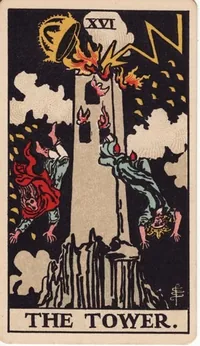
Look at how the three energies combine. Seven, the Chariot, gives you forward motion, a goal, and willpower — but without an inner core, that turns into a race for outward status symbols. Five, the Hierophant, is structure, rules, authority — and when you don't feel worthy of entering that structure, you start denying it instead. Sixteen, the Tower, is a sudden collapse of old constructions — here it plays out as tearing down other people's positions, which you perceive as a threat. You're not building your own tower — you're undermining other people's. Instead of learning from those who've achieved something, you devalue them. It's a defense mechanism: if you acknowledge their achievements, you'll have to acknowledge your own shortfall too. But it's exactly through acknowledging someone else that you could find your own footing. This triad's plot isn't about a fight — it's about how you're the one closing off your own path to authority.
How “Authority Through Respect” Shows Up

At work and with money, the program plays out as a series of moments. You see a coworker get promoted, and a thought flashes: 'He just got lucky' or 'He got in through connections.' You don't notice their contribution, because that would mean admitting you don't have results like that yourself. You might spread rumors about their mistakes, or make snide remarks about their projects. In the end, your income stays flat, and you're convinced the world is unfair. It's similar in relationships: you criticize your partner for not living up to your standards, while you yourself aren't ready to change. You devalue their achievements — 'so what, they bought a car' — and that creates distance. The people close to you feel your coldness, and the relationship turns into a battlefield. You don't even notice how you're pushing away the people who could have been your support. Instead of encouragement, you pour out sarcasm, and then wonder why you end up alone. The program also hits your self-esteem: the more you criticize others, the deeper your own insecurity gets. It's a closed loop, and there's a way out — start respecting other people's work. Once you learn to genuinely celebrate other people's wins, you open the door to your own authority.
Program 7-5-16 in 12 places in the matrix
This triad isn't a life sentence — it's a scenario you can live through consciously. In the Karmic Tail, it sounds like a recurring plot from the past: you keep cycling through the same kind of relationships, where either you're devalued or you devalue others, and you can't break the loop. In the Money Channel, the program shows up in how you earn: you might not charge for your services because you don't believe they're worth it, or, the opposite, overprice them and then can't hold up against competition. In the ancestral lines, it passes down a scenario of distrust toward authority — for instance, if there were betrayals in the family. Each placement gives a different sphere, but the pattern is the same: devaluation instead of acknowledgment. Look at the breakdowns below — find exactly where this combination sits for you, and you'll see which area of life plays out this scenario loudest.
As a child, you weren't respected — you either rebelled or earned praise through achievement. Now with your own children, you demand respect by force, instead of earning it.
Be an example: respect their choices, and they'll respect yours back.
Your talent is spotting the weak points in systems and people. But you use it for criticism instead of improvement.
Become a mentor: point out mistakes to help, not to humiliate.
You devalue other people's money and success to justify your own failures. Criticism instead of action is the main block in your finances.
Start small: acknowledge someone else's success and learn from it.
A recurring lesson — devaluing others so you don't have to feel worthless yourself. This pattern isolates you from real support.
Every time you want to criticize, find a reason to praise instead.
You believe money gives you the right to disrespect your partner. But the balance breaks down when one earns and the other just endures it.
Discuss financial decisions as equals, without criticism.
In a relationship, you criticize your partner to feel superior. But that destroys trust. Respect isn't about dominance — it's about recognizing someone as an equal.
Praise your partner out loud — it strengthens the bond.
You don't trust your own intuition, because you consider yourself not competent enough. Self-doubt drowns out your inner voice.
Keep a journal of your hunches — check how often they turn out right.
Your father didn't believe in his own abilities and passed down devaluing other people's achievements instead of growth.
Start acknowledging other people's success — it opens the path to your own authority.
The male line carries criticism of others as a way to mask your own insecurity around money.
Respect other people's achievements — it's the only way to become an authority in your field.
Your mother passed down gossip and envy instead of support, which is why you don't believe in your own talent.
Trade criticism for respect — it will strengthen your reputation.
The female line carries a devaluation of housework and daily labor, which is why you don't see your own worth.
Value other people's contribution to daily life — it will help you leave your own mark.
The main task of this period is becoming an authority through respect for others and yourself. You're capable of building a solid reputation if you acknowledge other people's achievements and learn from the best.
Don't miss this window for mentorship and partnership. Draw inspiration from successful people's examples and build your own legacy.
How to Work Through Program 7-5-16

First step: adopt a rule — once a day, find one achievement in a specific person that deserves respect, and tell them so directly. It could be a coworker, a partner, or even a stranger in line. Say it plainly, without irony. The goal is to break the automatic devaluation reflex. Do this for two weeks, and you'll notice the criticism in your head starting to quiet down.
Second step: keep an 'other people's wins' journal. Every evening, write down three achievements of people around you that you would have ignored before. It can be something simple — a neighbor finished a course, a friend ran a marathon. At the end of the week, read back through it and note what feelings come up. If envy shows up, that's a sign the program is speaking. Don't beat yourself up over it — just note it.
Third step: compare your real results to your own past ones, not to other people's. Every morning, write down one thing you achieved the day before — even something small. This trains your focus onto your own worth.
A sign the energy is shifting positive: you start looking for a reason to respect people instead of a reason to criticize them. You can genuinely say 'that's great work' without feeling a sting. Your own ambitions get a boost, and you notice you're moving toward your goals faster.
Program 7-5-16 at Its Worst and Its Best
The same energy sounds different depending on whether the program has been worked through.
| Area | − Unworked | + Worked Through |
|---|---|---|
| Money and Income | You devalue other people's ways of earning, calling them dishonest or lucky, while your own income stays stuck at the same level. | You notice other people's financial wins, borrow their working strategies, and steadily grow your own income. |
| Relationships | You nitpick your partner's hobbies and achievements, casting doubt on their merits — this destroys closeness. | You support your partner in their projects and celebrate their wins, which strengthens your bond. |
| Self-Esteem | You feel worthless when someone else gets praised, but instead of working on yourself, you get angry and critical. | You know your worth and calmly acknowledge other people's achievements — this gives you footing and confidence. |
| Working with People | On a team, you undermine other people's authority, spread rumors, create conflict, and end up isolated yourself. | You acknowledge everyone's contribution to the shared work, and the team respects you for your fairness. |
| Family and Ancestry | You devalue your parents' or children's achievements, believing they 'didn't really try,' and thereby continue the family pattern of distrust. | You respect the path taken by the people close to you, and this builds a tradition of support in the family. |
| Body and Resource | You compare your body to other people's and criticize their appearance, while your own condition only worsens from the stress. | You value your body for what it can do, and that gives you energy for health and activity. |
7-5-16 in Compatibility

In a couple's combined chart, this program shows up through the dynamics of respect. If your partner has the same triad, you may end up competing for the title of 'the important one,' devaluing each other. Then the relationship turns into a war. The worked-through version brings mutual support: you respect each other's strengths and build a partnership as equals. In the Compatibility Calculator, pay attention to which areas — money, feelings, or family ties — this combination activates in. It won't destroy anything if you're both willing to acknowledge each other's merits. Otherwise, the small crises will keep repeating.
A full calculation shows all 32 positions of the matrix and highlights whether triplet 7-5-16 is personally yours, and in which of the 12 places — and what to do about it.
Calculate My Matrix →Frequently Asked Questions

How 7-5-16 Differs From Similar Programs
Three combinations most often confused with this program, and the tell that shows which one is actually yours.
Programs Sharing Energies

Roman Mullet
I approach numerology as a symbolic system, not a predictive practice. The program “Authority Through Respect” describes a recurring scenario, not a sentence: triplet 7-5-16 has a positive side that opens up once it's worked through.
The texts for each place in the matrix on this page are the same ones the calculator shows in the paid report — one shared nomenclature, nothing tailored just for this page.
About the Author