
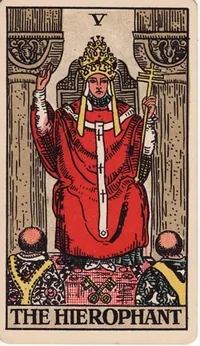


Program 5-19-14 “Money Is a Tool”
5 “The Hierophant” · 19 “The Sun” · 14 “Temperance”
The most common misconception about trio 5-19-14 is that it's a program for the rich, people who already have everything. It's exactly the opposite: the combination of 5 the Hierophant, 19 the Sun, and 14 Temperance describes a path from greed to abundance, and it most often shows up in people who are currently far from money. The program's name is 'Money Is a Tool.' It compresses money down to a goal, turning it from a means into an end in itself. It's important to understand right away: this trio can sit in twelve different spots on the matrix, and the position decides which sphere of life it governs. The essence stays the same — money as a tool, not a goal — but the 'volume' and the themes change.
Is 5-19-14 in Your Matrix?
The widget calculates the triplets across every place in the matrix from your date of birth and highlights where the program “Money Is a Tool” sits.
What the Three Numbers 5-19-14 Mean
Five is the arcanum of order, tradition, the mentor. In this trio it installs the belief 'money is earned through hard work, by the rules.' Nineteen is the arcanum of light, success, joy. It reaches for visibility, for shine, for making sure the result is noticed by others. Fourteen is the arcanum of measure, harmony, the golden mean. It's responsible for the ability to stop and feel: 'enough.' The plot is simple: the Five says 'work by the book,' the Sun demands 'shine,' and Temperance is supposed to balance these flows. But in the minus, Temperance turns into greed. A person wants more than they need and is afraid to stop. The energies form a trap: hoarding for hoarding's sake, perfectionism about money, comparing yourself to others. That trap is the essence of the program.
How “Money Is a Tool” Shows Up

At work and with money, program 5-19-14 sounds like this: you agree to tasks that bring no satisfaction, just because they pay. Every promotion is another reason to pile more on yourself, but there's no joy inside. You save for a 'rainy day,' but the day never comes. Income grows, but there's no sense of abundance. You constantly think other people got luckier. If money comes easily, you expect a catch: it feels like everything has to be paid for — with health, time, relationships. The paradox is that the tighter the grip, the more slips away. Investments don't pay off, clients go elsewhere, good deals fall through.
In relationships, the program shows up differently. You might choose a partner who's 'stable' financially but emotionally cold. Or, the opposite, you invest in the relationship like a project, demanding returns strictly by the rules. Jealousy here is a form of greed: you're afraid of losing what you consider yours. Gratitude comes hard. You notice your loved one isn't trying hard enough, even though objectively they're investing.
Another facet is self-esteem. Your worth is directly tied to the number of zeros in your account. When money is scarce, you feel worthless. When there's plenty, anxiety creeps in that it won't last. The body gets pulled into the program too: tension in the neck and shoulders, insomnia from thoughts about unresolved issues. You skimp on rest and food — and it looks rational, even though it drains your resource.
Program 5-19-14 in 12 places in the matrix
Now for an important step: program 5-19-14 isn't tied to one spot in the matrix. It can sit in twelve different positions — from the Karmic Tail to the Relationship Channels. The essence of the trio is always the same: 'money is a tool.' But the sphere it touches and the strength of its expression depend on position.
In the Karmic Tail, this combination is a recurring scenario from the past that we act out unconsciously. In the Money Channel, it's about how you earn and spend, exactly where you hit greed or the fear of scarcity. In the ancestral lines, it points to inherited beliefs about money passed down from your ancestors. In the center of the matrix, it's a personal program affecting every sphere at once.
Below is a breakdown for each position. You'll see where this plot sits on your chart, and how to turn it around.
As a child, money was a source of conflict or control. Now you may repeat the same scenarios with your own children — giving gifts instead of attention. Money is a tool for creating a warm atmosphere, not a substitute for love.
Spend an hour with your child without spending any money: a walk, a game, a conversation.
Your talent is creating value, but you undervalue your own work, working for an idea instead of pay. Money is a tool for scaling your gift.
Monetize one of your skills: turn a hobby into a micro-business.
You chase big sums, but the more you earn, the stronger the fear of losing it becomes. Greed narrows your options. Money is a tool for growth, not a measure of success.
Invest 10% of your income in learning — it will expand your money flow.
A recurring pattern: you lose money because of greed or dishonest schemes. In the past it was a lesson; now it's a habit. Money is a tool, and how you handle it determines the outcome.
Keep a transparent budget and set aside 10% for charity — this changes your relationship with money.
You believe money and love are incompatible: either a wealthy career or a happy family. Money is a tool for creating the stability that lets relationships flourish.
Build a budget that includes a line for shared joys — trips, gifts, dinners out.
In relationships you may confuse care with spending money. Your partner feels bought rather than loved. Money is a tool for shared experiences, not control.
Arrange a date that costs nothing but demands attention: cook dinner together.
Your intuition often tells you money is 'dirty' or that you don't deserve wealth. These beliefs block your income. Money is a tool — a neutral resource that can be used for good.
Every time you feel guilty about money, say: 'I use it for good.'
The paternal line instilled a pattern of hoarding knowledge without sharing it.
Monetize your expertise and turn it into value for others.
The men of your lineage passed down a scenario of earning to accumulate without a purpose.
Set financial goals tied to a mission and to growth.
The female line passed down the belief that money is evil or dirty.
Rewrite the belief: money is energy for good deeds.
From the maternal line comes the habit of skimping on yourself out of a fear of poverty.
Invest in your own development and quality of life.
In this period you stop chasing money as an end in itself and start seeing it as a tool for creating value. Finances come through service and generosity.
Bet on charity or investing in others' development — that's how you'll open your money flow.
How to Work Through Program 5-19-14

First step: make a list of your monthly expenses. Next to each item, write whether that spending was a pleasure or an investment. Separately, list the expenses you make 'for show' — to impress someone. In a week, reread the list and underline three items you could cut without losing quality of life. Sign of the plus: you stop feeling guilty about every dollar you spend on yourself.
Second step: pick one thing you keep putting off because it doesn't bring money right now. For example, a hobby, a course, volunteering. Set aside two hours a week for it over a month. Watch the feeling: this activity should give you energy, not drain it. If after a month you feel interest rather than irritation, the program is moving positive. If you want to quit, go back to the motivation: money is a tool, not a reason to deny yourself joy.
Third step — a gratitude practice: every evening write down three things you're grateful for that day, with one always tied to money — a lucky parking spot, a cup of coffee. After three weeks, notice: has it become easier to see opportunities instead of scarcity? If yes, you're on the right track.
Program 5-19-14 at Its Worst and Its Best
The same energy sounds different depending on whether the program has been worked through.
| Area | − Unworked | + Worked Through |
|---|---|---|
| Money and income | You save for a 'cushion,' but your home is falling apart; income grows, yet spending on necessities triggers panic and guilt. | You spend on comfort calmly, seeing it as a tool for restoring your resource; income is stable, and you can allocate it without fear. |
| Relationship with a partner | You choose a partner for financial stability but stay emotionally cold with them; jealousy comes from a fear of losing your invested resources. | You value your partner's human qualities, not just their income; the relationship is built on equal investment, without tallying 'who put in how much.' |
| Self-esteem and worth | Your self-worth is directly tied to your bank balance; when broke you feel worthless, when comfortable you fear it won't last. | You feel valuable regardless of your finances; you see money as a resource you can create, not proof of your significance. |
| Work and career | You agree to overtime for the money, you burn out, but refuse vacation because 'you can't lose income.' | You choose projects that bring both money and satisfaction; you know how to rest, knowing a short pause raises your effectiveness. |
| Family and lineage | Family stories are full of talk about not having enough money; the older generation demands you 'not stick out,' and you inherit that belief. | You create new scenarios of abundance for your lineage; you talk about money calmly, without linking it to danger or shame. |
| Body and resource | You skimp on your health: skipping checkups, buying cheap food; chronic fatigue is treated as normal. | You invest in your body as your main tool: quality food, exercise, prevention; your energy recovers faster, and you feel a surge of vitality. |
5-19-14 in Compatibility

In compatibility, trio 5-19-14 shows up in the couple's financial scenarios. If it sits in one partner's money zone, the relationship can be built around mutual expectations in the material sphere. In the plus, such a couple creates shared abundance, calmly discussing budget and investments. In the minus, one partner may control the finances, suffocating the other, or both save for the future while forgetting to live now. To check how the trio works for you, use the compatibility calculator. It will show which spheres your programs align in and where friction might arise.
A full calculation shows all 32 positions of the matrix and highlights whether triplet 5-19-14 is personally yours, and in which of the 12 places — and what to do about it.
Calculate My Matrix →Frequently Asked Questions

How 5-19-14 Differs From Similar Programs
Three combinations most often confused with this program, and the tell that shows which one is actually yours.
Programs Sharing Energies

Roman Mullet
I approach numerology as a symbolic system, not a predictive practice. The program “Money Is a Tool” describes a recurring scenario, not a sentence: triplet 5-19-14 has a positive side that opens up once it's worked through.
The texts for each place in the matrix on this page are the same ones the calculator shows in the paid report — one shared nomenclature, nothing tailored just for this page.
About the Author