

Program 18-5-5 “Knowledge Without Boundaries”
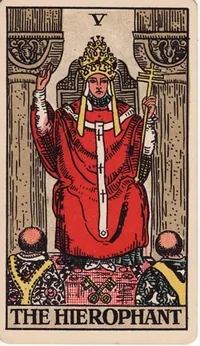
18 “The Moon” · 5 “The Hierophant” · 5 “The Hierophant”
The most common misconception about this triad is that it means a 'special gift' or 'hidden abilities.' In fact, 18-5-5 is a program called Knowledge Without Boundaries. It has three energies: the 18, the Moon, and two 5s, the Hierophant. Together they form a storyline where you use knowledge selfishly or cross other people's boundaries — or where you idealize family and fear imperfection, which makes you avoid closeness. Important: this triad appears not only in the Karmic Tail but in twelve different spots on the chart. The position decides the sphere, and the core stays the same.
Is 18-5-5 in Your Matrix?
The widget calculates the triplets across every place in the matrix from your date of birth and highlights where the program “Knowledge Without Boundaries” sits.
What the Three Numbers 18-5-5 Mean
The 18, the Moon, brings intuition, the subconscious, fears, and illusions. It's like an undercurrent you don't see but feel. The two 5s, the Hierophant, amplify the theme of knowledge, tradition, rules, and family. In this combination, the Moon shakes up your emotional state while the Hierophant adds demands about 'how things should be.' Together they create an inner conflict: you know a lot, you sense subtle processes, but you apply it not to grow but to control, or to protect your own illusions. For example, you use psychological tricks to manipulate someone close to you, or you pass off your fantasies as reality because you're afraid to see the truth. The double 5 puts the emphasis on repetition: the scenario replays in your relationships again and again, until you break through by accepting the world's imperfection.
How “Knowledge Without Boundaries” Shows Up

At work and with money, this program plays out like this. You might be an expert who accumulates knowledge but uses it to feel superior. At work you notice other people's mistakes and point them out, while avoiding responsibility yourself. Or you use insider information to negotiate better terms, but in doing so cross other people's boundaries — laying on the guilt, for instance. Money comes through intellect, but it slips away because you either undervalue your own work or get pulled into questionable schemes chasing the illusion of easy money.
In relationships, the program plays louder. You idealize your partner or family as a whole. You expect the people close to you to match your picture: always understanding, caring, flawless. When reality doesn't line up, you either suffer in silence or devalue the relationship. Men often withdraw, burying themselves in work or hobbies to avoid heart-to-heart conversations. Women may control their partner, check their phone, demand a report on every move. All of it is an attempt to hold on to the illusion of a perfect family. Closeness feels scary because it exposes imperfection — yours and theirs.
Program 18-5-5 in 12 places in the matrix
You already know the core of this triad. Now it's important to figure out where it sits in the chart. The principle is this: the energies stay the same, but the sphere and 'volume' depend on the position. In the Karmic Tail, it's a repeating scenario from the past that trails you into your current life. In the Money Line, the program is tied to income: how you earn, spend, and relate to money. In the ancestral lines, you inherit this storyline from your family, and it affects your relationship with them. In other positions — manifestation, talents, purpose — the program shifts its emphasis, but the core stays the same: knowledge and boundaries. Below are breakdowns by position. Find your own spot in the chart and read that block.
You idealize your parents and fear their imperfection. Because of this you keep your distance, or try to 'improve' them through advice and control.
Accept that your parents are ordinary people. Your job isn't to fix them but to build an adult relationship.
You're able to dig deep into any subject and see connections others miss. But you risk getting buried in theory without practice.
Apply your knowledge in practice. Your talent is connecting scattered fields into practical solutions.
You use knowledge to make quick money, often crossing other people's boundaries. The idea of 'easy money' pulls you away from real income.
Sell deep expertise, not schemes. Honest work will bring you steady income.
A repeating pattern: crossing other people's boundaries for personal gain. In the past you may have used knowledge to manipulate.
Consciously respect other people's freedom. It will break the cycle and bring lightness.
You try to find balance between money and love, but fear that one rules out the other. You choose career at the expense of relationships.
Learn to combine the two: create projects together with your partner, or find income in a field connected to care.
You idealize your partner and fear they're imperfect. You avoid closeness to protect yourself from disappointment.
Let your partner be real. Closeness is built on acceptance, not illusions.
You read people and situations well, but often confuse intuition with paranoia. Afraid of being deceived, you shut down.
Trust your first impression, but check it against facts. Your intuition is accurate when you're calm.
Through the paternal line comes a tendency toward intellectual dominance and crossing boundaries.
Develop respect for other people's space and use knowledge to help.
Your father's material experience taught you to idealize prosperity, but fear imperfection.
Accept instability as normal and build your finances on flexibility.
Through the maternal line comes a fear of closeness rooted in fear of imperfection.
Develop your intuition and creativity, respect other people's freedom.
Your mother's material experience taught you to sacrifice yourself for a perfect home.
Create harmony at home without self-sacrifice.
The period's main task is to accept the world's imperfection. By respecting other people's boundaries and developing your intuition, you'll build harmonious relationships and realize your creative potential.
Don't miss the moment: start exploring a new field without fear of getting it wrong — knowledge will become your superpower.
How to Work Through Program 18-5-5

First step: track the moments when you use knowledge to prove you're right or gain an advantage. Notice, for instance, when you cite research in an argument just to make someone else look stupid. The moment you catch yourself doing it, stop and ask: 'Do I need to be right, or do I need to stay connected?' Practice asking the other person: 'What do you think?' — and actually listening to the answer instead of preparing a counterargument. A sign of the plus: you more often finish conversations feeling like you learned something new, not like you won.
Second step: practice an 'imperfect evening.' Once a week, deliberately do something spontaneous, with no plan and no rules. Dinner made from whatever's in the fridge, a walk with no route, a conversation with no topic. The goal is to experience something with no 'right' or 'wrong.' Notice which part of you resists and wants to control everything. A sign of the plus: you start enjoying the unplanned instead of feeling anxious about it.
Third: once a day, tell yourself or write down: 'I respect other people's boundaries.' It's not an affirmation, it's a reminder. Check your own behavior: are you pushing your opinion on someone, reading other people's messages, deciding things for the people close to you? A sign of the plus: people tell you more often that they feel free around you.
Program 18-5-5 at Its Worst and Its Best
The same energy sounds different depending on whether the program has been worked through.
| Area | − Unworked | + Worked Through |
|---|---|---|
| Money | You earn through your intellect, but you lose income to illusions: you invest in questionable schemes, believe promises of quick profit, and break agreements for short-term gain. | You monetize knowledge honestly: you build products or services that genuinely help people, and you earn a steady income without crossing other people's boundaries. |
| Relationships | You build relationships with an ideal image of a partner rather than a real person. When the real person doesn't match the picture, you either devalue them or try to remake them, which leads to conflict and cooling off. | You accept your partner along with their flaws and quirks. You understand that no one's perfect, and you build a warm relationship on honesty rather than expectations. |
| Self-Esteem | You measure your worth by how much you know and can do. If you don't know something or make a mistake, you feel worthless, hide the gap, and fear looking stupid. | You understand that knowledge isn't the whole point. You're valuable in yourself, even when you don't know something. Mistakes are experience, not a verdict. |
| Working With People | At work you manipulate information: you withhold what matters to look indispensable, or you exploit other people's weaknesses to push your point of view. | You share knowledge openly, help your colleagues grow, and people respect you for your honesty and support, not for intimidation. |
| Family and Ancestry | You feel you have to live up to family expectations even when they clash with your own wishes. It builds resentment toward the people close to you, and you avoid family gatherings. | You keep your respect for your family, but you live by your own rules. You spend time with relatives without guilt, and you know how to hold your boundaries gently. |
| Body and Resource | You ignore your body's signals until exhaustion or illness knocks you down. You think rest is weakness, and you live in 'prove you deserve it' mode. | You know how to rest on time and stay attuned to your own needs. You understand that caring for your body is the foundation, not a luxury, and you live at a calmer pace. |
18-5-5 in Compatibility

In a couple's chart, this triad in one partner creates tension if the other doesn't meet expectations. Idealizing family means the real person always seems not quite good enough. A cycle forms: you demand, your partner falls short, you get disappointed. Once worked through, you build the relationship on acceptance instead of demands. Intuition helps you sense your partner, and knowledge helps you find compromises. To check how compatible you are with this program factored in, use the Compatibility Calculator — it'll show where your energies align and where they create friction.
A full calculation shows all 32 positions of the matrix and highlights whether triplet 18-5-5 is personally yours, and in which of the 12 places — and what to do about it.
Calculate My Matrix →Frequently Asked Questions

How 18-5-5 Differs From Similar Programs
Three combinations most often confused with this program, and the tell that shows which one is actually yours.
Programs Sharing Energies

Roman Mullet
I approach numerology as a symbolic system, not a predictive practice. The program “Knowledge Without Boundaries” describes a recurring scenario, not a sentence: triplet 18-5-5 has a positive side that opens up once it's worked through.
The texts for each place in the matrix on this page are the same ones the calculator shows in the paid report — one shared nomenclature, nothing tailored just for this page.
About the Author