
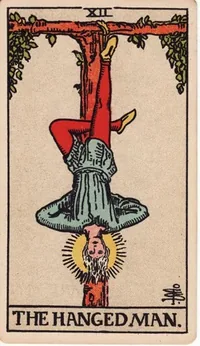
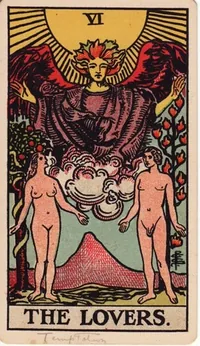
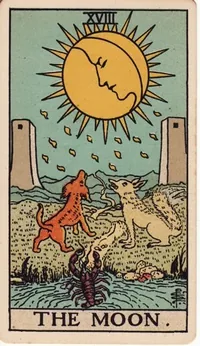
Program 12-6-18 “Self-Sufficiency”
12 “The Hanged Man” · 6 “The Lovers” · 18 “The Moon”
The 12-6-18 "Self-Sufficiency" program combines the energies of The Hanged Man, The Lovers, and The Moon. Its essence is dependence on others, a lack of inner footing, and living for other people's expectations. The way out is through developing emotional intelligence, building personal boundaries, and learning to enjoy things without guilt. This triplet differs from neighboring programs in that its core is separation itself, not just insecurity or emotional swings. This combination of energies doesn't have to sit in the Karmic Tail. It can appear in different places on the chart — in the channels, in the yearly positions, in the financial block. The area of life it shows up in (money, relationships, family) and its intensity depend on the position, but the essence of the program stays the same. On this page, the engine will fill in the breakdown for each of the twelve positions, and you'll learn the general mechanics and the principles for working through it.
Is 12-6-18 in Your Matrix?
The widget calculates the triplets across every place in the matrix from your date of birth and highlights where the program “Self-Sufficiency” sits.
What the Three Numbers 12-6-18 Mean
The 12-6-18 triplet comes together into one storyline: you see yourself only through your relationships with others. The Hanged Man gives you a readiness to sacrifice yourself, to tolerate discomfort, to "hang" in a suspended state — anything not to break the connection. The Lovers add an emotional attachment, a longing to merge with someone, and a fear of losing your partner, along with a need to make a choice that you keep putting off. The Moon highlights the fog: you don't always know what you actually want, you doubt your own desires, and you see reality through a lens of anxiety and illusion. Together, these three energies create a mechanism of self-denial: you seem to be "choosing" another person, but you're really choosing to avoid yourself. Guilt becomes a tool of control — others manage you through a sense of obligation, and you use guilt yourself to avoid taking responsibility for your own life. The key knot here is a fear of your own autonomy.
How “Self-Sufficiency” Shows Up

In relationships, the program shows up as constantly adjusting yourself to your partner. You cancel plans if someone close to you "needs" you, even when it comes at the expense of your own affairs. You put their needs above your own, forgetting to ask what you actually want. If your partner asks for some time alone, you feel anxious and guilty, as if you did something wrong. In conflicts, you're the first to give in, afraid of being left. Meanwhile, irritation builds up inside that you never express directly — it comes out as passive aggression or resentment instead. At work and with money, the program sounds different: it's hard for you to ask for fair pay, you take on other people's tasks to "help," and end up burned out. Money feels like something you have to earn through suffering — easy income makes you suspicious. You might stay in a job you dislike for a long time because you're afraid of disappointing your team or your boss. Your self-esteem depends directly on praise: if no one praises you, you feel worthless. In the body, this often shows up as chronic fatigue, a sense of heaviness, and trouble resting: even when you have the time, you can't relax, because spending time on yourself feels "shameful."
Program 12-6-18 in 12 places in the matrix
Before breaking down the specific positions, it's worth understanding the principle. The essence of the 12-6-18 triplet is always the same — dependence and losing yourself in others. But the area of life where the program plays out loudest depends on its position on the chart. In the Karmic Tail, it reads as a recurring pattern from the past: you keep landing in the same kind of relationship, over and over, where you dissolve into the other person. In the Money Line, the same combination is tied to income: you earn by sacrificing yourself, and you don't know how to accept money without giving something back. In the Ancestral Square, it's an inherited pattern: your ancestors lived this way, and you're continuing it. The closer the triplet sits to the center of the chart, the more actively it shapes your personal choices; the further out it sits, the more it resembles background noise. The engine will fill in a detailed breakdown for each of the twelve positions, and right now you'll get tools for working with it regardless of position.
As a child, you often felt guilty for not living up to expectations. Now you're separating from your parents' scripts.
Build boundaries with love, not resentment.
Your gift is empathy and the ability to care for others. But without boundaries, it drains you. Point it at yourself too.
Taking care of yourself isn't selfish — it's the foundation.
You earn, but you give away more than you take. Relying on your own resources is the key to financial stability.
Learn to accept money as gratitude, not as a debt.
The recurring pattern is living for others and forgetting yourself. The way out is to stop being the rescuer.
Every time you feel guilty, ask yourself: what do I actually want?
Money and love are in conflict for you: either you earn, or you build a relationship. Balance comes when you're whole on your own.
Combine the two: find a partner who supports your income.
In a couple, you dissolve into your partner, afraid of being alone. Self-sufficiency isn't about isolation — it's about being whole inside.
Fill yourself up first, then share.
You sense others with great subtlety, but you confuse their needs with your own. Telling apart your own signals from other people's is a skill.
Check yourself: is this my own desire, or someone else's?
From your father's side, you inherited a pattern of serving others at your own expense.
Separate your spirituality from guilt, and find your inner footing.
The paternal line reinforced a dependence on other people's opinions when it comes to money.
Build financial boundaries and learn to earn for yourself.
Down the maternal line comes self-sacrifice and emotional fusion with others.
Develop your emotional intelligence and give yourself permission to be a separate person.
The maternal line passed down guilt over comfort and everyday material wellbeing.
Learn to accept care and enjoy comfort without remorse.
This period reveals you as a self-sufficient person. You're learning to rely on yourself, build healthy boundaries, and enjoy your own company. The main task of this period is to find your inner footing and stop living for other people's expectations.
Put your focus on developing emotional intelligence and personal comfort rituals. Build relationships where your boundaries are respected.
How to Work Through Program 12-6-18

Start by checking your personal boundaries. For one week, note the moments when you agree to something purely out of guilt or fear of offending someone. Each day, pick one situation where you usually give in, and practice answering: "I need time to think about it" or "I'm not ready to do that." Even if you're shaking inside, the action still counts as a success. Within a month, you'll notice that the requests you used to agree to "for others" start drying up — the people around you will adjust to your new baseline. The second exercise is the "comfort without guilt" practice. Once a day, do something pleasant purely for yourself, with no explanations and no need to earn it: a bath, a walk, good food. It's important to notice the guilt when it shows up and not run from it — just stay with it while you keep going. This way, you retrain your psyche: enjoyment doesn't require justification. The third step is separation in your finances. If you're used to spending and giving "on demand," start setting aside a small amount in a separate account "for yourself," and spend that money only on yourself, with no sense of obligation. The sign that this energy is turning positive: you feel calm when you say no, and you no longer feel the need to constantly explain your actions to others.
Program 12-6-18 at Its Worst and Its Best
The same energy sounds different depending on whether the program has been worked through.
| Area | − Unworked | + Worked Through |
|---|---|---|
| Relationships | You're absorbed in your partner, canceling your own plans, afraid that saying no will break the connection, and putting up with discomfort for someone else's sake. | You hold on to your own interests, know how to say "no," handle disagreements calmly, and feel whole even next to someone else. |
| Money | You earn through exhaustion, never ask for a raise, feel ashamed of easy income, and would rather work for free than say no. | You accept payment for your work without guilt, ask for fair amounts, plan your budget, and let yourself spend on things you enjoy. |
| Self-Esteem | Your worth depends on other people's opinions, you seek approval, and criticism throws you off balance for days. | You're confident in your decisions, rely on your own inner standards, praise yourself, and don't wait for constant validation from outside. |
| Working with People | You take on other people's tasks to earn their love, overload yourself, but you're afraid to delegate — or you'd stop being the "indispensable martyr." | You distribute responsibilities, defend your own areas of ownership, help when you actually have the capacity, and feel no guilt for saying no. |
| Family and Ancestry | You repeat your parents' pattern: you serve the family, tolerate invasions of your personal space, and feel obligated to "save" your relatives. | You set distance with relatives, don't let anyone manipulate you through guilt, and create your own family rules, different from your parents'. |
| Body and Energy | Constant fatigue, a feeling of being "wrung out," and an inability to relax because rest feels like a waste of time. | You feel a surge of energy, know how to rest without guilt, take care of your health, and consider self-care a norm, not a luxury. |
12-6-18 in Compatibility

In a couple's chart, this triplet shows who takes on the role of the "rescuer" and who becomes the "needy one." If one partner has the 12-6-18 program, they tend to dissolve into the other, losing themselves, while the other partner may unconsciously take advantage of that. The key to compatibility is not tipping into the imbalance of "one sacrifices, the other consumes." Both partners need to work on separation and learn to be self-reliant. Then the relationship shifts from karmic to a true partnership, where each person relies on themselves and shares resources instead of demanding rescue. To see how this program interacts with your couple's energies, use the compatibility calculator — it will show you where you align and where tension can build.
A full calculation shows all 32 positions of the matrix and highlights whether triplet 12-6-18 is personally yours, and in which of the 12 places — and what to do about it.
Calculate My Matrix →Frequently Asked Questions

How 12-6-18 Differs From Similar Programs
Three combinations most often confused with this program, and the tell that shows which one is actually yours.
Programs Sharing Energies

Roman Mullet
I approach numerology as a symbolic system, not a predictive practice. The program “Self-Sufficiency” describes a recurring scenario, not a sentence: triplet 12-6-18 has a positive side that opens up once it's worked through.
The texts for each place in the matrix on this page are the same ones the calculator shows in the paid report — one shared nomenclature, nothing tailored just for this page.
About the Author