
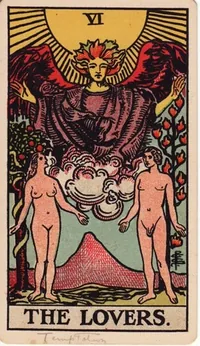
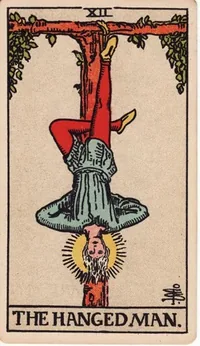
Program 6-12-6 “Love as Duty”
6 “The Lovers” · 12 “The Hanged Man” · 6 “The Lovers”
You've canceled plans with friends again because your partner said they weren't feeling well. For the hundredth time you tell yourself, "Well, who else if not me?" — and you stay. It happens so often that you no longer notice how, by the end of the week, you have no energy left, no desire, not even your own plans.
The numbers 6-12-6 — "Love as Duty" — are one of the most common karmic programs in the Destiny Matrix. The Lovers, appearing twice, create a deep need for closeness and harmony. The Hanged Man in the middle brings a readiness to sacrifice yourself. When these energies sit together, love turns into service, and service turns into self-destruction. This triplet appears in the Karmic Tail and in other zones of the matrix. The position determines which area it presses on — money, relationships, family, or career. But the essence stays the same: you give too much, leaving nothing for yourself.
Is 6-12-6 in Your Matrix?
The widget calculates the triplets across every place in the matrix from your date of birth and highlights where the program “Love as Duty” sits.
What the Three Numbers 6-12-6 Mean
The 6 in this triplet appears twice, at both ends. It sets the frame — the theme of relationships, choice, partnership. In the middle sits the Hanged Man, who flips that theme on its head: love is seen through duty, through obligation. Together these energies form a plot: you look for love but enter it through sacrifice. You choose a partner who needs saving, and you stay with them even as the relationship wears you down.
In everyday life this looks like: you take on other people's problems, excuse a loved one's coldness, put their interests above your own. The Lovers want harmony; the Hanged Man agrees to suffer for it. Together they create a loop: the more you sacrifice, the more gratitude you expect, and the more it hurts when it doesn't come. But you keep going, because leaving feels like betrayal.
This combination shapes your actions and your sense of self: you feel worthwhile only when someone needs you. A pause, the question "what do I want?" — triggers guilt. That's why the program holds on so tightly.
How “Love as Duty” Shows Up

In relationships, the 6-12-6 program shows up as a habit of being "convenient" and "needed." You're the first to notice your partner is tired and immediately offer help, even if you're exhausted yourself. You say "yes" to requests that have already become routine, and stay quiet when something bothers you, so as not to start a conflict. Gradually your boundaries erode: you cancel time with friends, put off your own tasks, then feel tired and irritated but are afraid to admit you're struggling. Eventually your partner gets used to this giving and stops noticing your effort — it becomes the baseline. You feel hurt, but you don't say anything, so as not to look selfish.
At work and with money, the same program plays out differently. You take on overtime because a colleague "can't cope." You accept a below-market salary because you're afraid of looking pushy. You pour effort into a project that drains your resources, then don't ask for a raise because it feels "awkward." Here the sacrifice shows up as an inability to ask or to say no. You're convinced that if you try harder, you'll be noticed and appreciated. But in reality this leads to burnout and resentment toward the people who "climbed on your back."
Self-worth deserves a separate mention. Under this program it rests on outside approval: you feel good about yourself only when you're doing something for someone else. If nobody asks for help, you start to feel anxious and look for a way to be useful. This is the "rescuer" script, someone who doesn't know how to just be themselves. At its worst, you don't notice that your worth isn't the same as your usefulness. At its best, you start letting others take care of you and stop feeling guilty about resting.
Program 6-12-6 in 12 places in the matrix
Now for the main point. This triplet isn't confined to one place of power. It can sit in different zones of the matrix, and that changes which sphere it affects.
In the Karmic Tail, the 6-12-6 program is a recurring scenario from the past: you keep returning to the same kind of relationship, sacrificing yourself, unable to break the cycle. In the Money Line, it's the same plot but about income: you pour effort into work without fair pay, as if you were doing it "for the cause." In the Ancestral Square, it's an inherited pattern of behavior: your family accepted enduring hardship for love's sake, and you repeat it.
The position only determines where the program speaks loudest. The essence is always the same: love as duty. Below is a detailed breakdown of every position where it can appear.
As a child you felt that love had to be earned — your parents valued your help and obedience more than your wishes. Now, with your own children, you repeat this script, expecting care from them in return.
Give your children unconditional love, not tied to what they do — this breaks the cycle of "duty instead of closeness."
Your gift is empathy and care so acute it borders on uncanny — you feel others' moods and pain as your own. This makes you invaluable in helping professions.
Channel your talent into paid work (psychology, medicine, social work) — your empathy should bring in income, not just exhaustion.
You earn through service — helping others, solving their problems — while putting your own financial interests dead last. Money comes in, but there's always someone it "needs to go to."
Stop working for free or for a "thank you" — your work has a price, and you need to say it out loud.
The recurring lesson: you choose partners who demand sacrifice, and you prove your love through suffering. In a past life, you may have been the one who took without giving — now you're working it off.
Recognize this: love doesn't equal suffering. Choose people who love you unconditionally, not people who need "saving."
You sacrifice money for love and love for money — the extremes toss you from side to side. Either you work yourself to the bone, forgetting your partner, or you dissolve into the relationship and lose income.
Set clear boundaries: time for work and time for family — don't mix them. This isn't separation, it's respect for both areas.
In love you give everything, holding nothing back, forgetting your own needs. Your partner gets used to your self-sacrifice and stops appreciating it. You feel drained but are afraid to ask for help.
Introduce a rule: "give two, ask for one" — a balance of giving and receiving will strengthen the relationship, not break it.
Your intuition is tuned to other people's needs — you read what others require, but you don't hear your own signals. You often act against your own interest because "that's the right thing to do."
Before you help someone, ask yourself: "What do I need right now?" — that's not selfishness, it's self-preservation.
Your father instilled a duty to serve — putting others' interests above your own.
Rethink what care means to you: start with yourself.
The paternal line passed down a pattern of working yourself to the bone for the family.
Replace burnout with a sustainable pace — you'll last longer that way.
Your mother taught you to dissolve into love, losing your boundaries.
Build an inner foundation so you can love without losing yourself.
The maternal line carries the habit of giving away the last of what you have at home.
Set a rule: your own base comes first, helping others comes second.
In this period you build deep connection through care and responsibility. Love stops being a duty and becomes a conscious choice — and that brings real closeness.
Bet on balance: give, but don't lose yourself. Don't miss the chance to refill your own resources.
How to Work Through Program 6-12-6

The first step is to set the "30% for me" rule. Before agreeing to help, ask yourself: "What will I have left for myself after this?" If helping leaves you with less than a third of your resources — time, money, energy — practice saying "no." This isn't selfishness; it's the foundation for healthy relationships. Start small: turn down one request that isn't critical, and notice what you feel. Guilt is a normal reaction — it will pass.
The second step is to stop guessing your partner's or coworker's needs for them. If someone doesn't ask — don't offer. This is hard, because you're used to feeling other people's pain as your own. But as long as you're solving other people's problems, you're not solving your own. Keep a journal: note how many times a day you did something for someone without being asked. After a week, you'll see the scale of it.
The sign that the energy has turned positive is that you start having your own plans that you don't cancel for other people's urgent business. You begin to feel that rest isn't a reward but a necessity. And, most importantly, the people close to you don't turn away when you say "no." They learn to respect your boundaries. Remember: doing this work doesn't mean giving up care — it means giving that same care to yourself.
Program 6-12-6 at Its Worst and Its Best
The same energy sounds different depending on whether the program has been worked through.
| Area | − Unworked | + Worked Through |
|---|---|---|
| Relationships | You stay with a partner who gives you no warmth but demands care, excusing it with their own problems. | You choose a partner capable of an equal exchange, and you can talk about your needs without guilt. |
| Money and work | You accept a low salary and overtime because you're afraid to "ask" and "bother" your boss. | You value your work fairly, ask for decent pay, and know how to walk away from a project that drains you. |
| Self-worth | You feel valuable only when helping others and don't believe you can be wanted just for who you are. | You know your worth independent of your usefulness and let others take care of you with no strings attached. |
| Boundaries | You say "yes" to requests even when you have nothing left to give, and stay quiet about your discomfort so as not to hurt anyone. | You calmly say no when a request conflicts with your plans, and explain it without apologizing. |
| Ancestry and family | You repeat the family script: enduring hardship for the people close to you, ignoring your own wants, "so as not to let them down." | You build relationships differently from your parents and don't take on the debt of their expectations. |
| Body and resources | You ignore fatigue, work yourself to the bone, and get sick often because you won't let yourself rest. | You keep track of your condition, rest before you "run out," and feel no guilt about taking a pause. |
6-12-6 in Compatibility

In a couple's matrix, this program reads as a tendency toward an unequal exchange. One partner sacrifices, the other receives. Over time this leads to mutual dissatisfaction: the one sacrificing gets tired, the one receiving gets used to it.
If your partner doesn't share the same tendency in their compatibility reading — or, on the contrary, has a strong Justice energy (Arcanum 8) — conflicts are possible: they won't understand why you "don't love yourself." The good news: a worked-through 6-12-6 in a couple produces deep empathy and care that becomes a support for both of you.
To assess your specific pairing, use the compatibility calculator on the site — it will show where the two matrices overlap and which programs get amplified.
A full calculation shows all 32 positions of the matrix and highlights whether triplet 6-12-6 is personally yours, and in which of the 12 places — and what to do about it.
Calculate My Matrix →Frequently Asked Questions

How 6-12-6 Differs From Similar Programs
Three combinations most often confused with this program, and the tell that shows which one is actually yours.
Programs Sharing Energies

Roman Mullet
I approach numerology as a symbolic system, not a predictive practice. The program “Love as Duty” describes a recurring scenario, not a sentence: triplet 6-12-6 has a positive side that opens up once it's worked through.
The texts for each place in the matrix on this page are the same ones the calculator shows in the paid report — one shared nomenclature, nothing tailored just for this page.
About the Author